
Academic Information
Degree Conferment Policy
At Shinshu Honan Junior College, the following policies are set as the common standards for graduation and degree conferment:
- Students should strive to develop rich intellect and sensitivity, demonstrating a deep understanding of humanity as responsible members of society.
- Students should acquire specialized knowledge and skills, and be able to exercise sound judgment and take appropriate action according to each situation.
- Students should value family, friends, and peers, and find meaning in building trusting relationships with others.
Degree Conferment Policy — Language and Communication Program
Students who have earned the required credits and meet the following conditions will be awarded the Associate Degree (Language and Communication).
- Knowledge and Understanding: Possess a broad education and specialized knowledge that contribute to society, with a deep understanding of their essence.
- Skills and Expression: Acquire practical skills, qualifications, and information literacy, demonstrating strong communication abilities required in professional life.
- Thinking and Judgment: Be able to identify various issues and challenges and think and make decisions logically and independently.
- Interest, Motivation, and Attitude: Show interest in human, social, and cultural issues, proactively engage with others, and demonstrate the willingness to take initiative in solving problems.
【View the Learning Outcomes for the Language and Communication Program】
Degree Conferment Policy — Early Childhood Education Program
Students who have earned the required credits and meet the following conditions will be awarded the Associate Degree (Early Childhood Education).
- Understanding of Early Childhood Education:Demonstrate a willingness to continue learning independently, possess a strong sense of mission and morals as a childcare professional and supporter, and engage empathetically with children and others in need of care.
- Understanding of the Child and Development:Understand the essence of childcare and possess solid knowledge of child growth, development, and the surrounding environment.
- Methods and Skills in Childcare: Acquire basic childcare skills and a well-rounded education that enables the practice of compassionate, hands-on childcare and support for children and others requiring assistance.
- Logical Reasoning: Comprehend and analyze social issues, demonstrating the ability to think critically and pursue effective solutions.
- Practical Abilities and Team Efforts:
As an active member of society, work cooperatively with diverse individuals and contribute positively to community and social development through personal experience and engagement.
【View the Learning Outcomes for the Early Childhood Education Program】
Admission Policy, Number of Enrolled Students, and Current Student Enrollment
School Mission and Admission Policy
The founding spirit of Shinshu Honan Junior College is “Independence and Self-Reliance.” Guided by this educational philosophy, the college offers a unique curriculum and learning system aimed at nurturing individuals who can contribute positively to society.
We seek students who share this vision — those who dream about the future, confront challenges with enthusiasm, and are eager to learn and grow through their own efforts.
Anticipated Qualities of Students in the Language and Communication Program
- Knowledge and Understanding: Individuals with the basic academic ability in Japanese, English, and other areas necessary to acquire specialized knowledge and a broad education.
- Skills and Expression: Those eager to develop strong communication skills through language and to use their qualifications and abilities to contribute to society.
- Thinking and Judgment: Students who can think and make sound decisions independently and aim to become self-reliant individuals.
- Interest, Motivation, and Attitude: Those with a genuine interest in people, society, and culture, and who approach challenges proactively as their own.
Anticipated Qualities of Students in the Early Childhood Education Program
- Individuals with a strong motivation to learn proactively
- Those with the basic academic ability to succeed in a junior college program
- Those who can work collaboratively as a team
- Students dedicated to improving their childcare and education skills
Faculty Organization, Academic Degrees, and Achievements
Number of Faculty Members:
Department of Language and Communication (as of May 1, 2025)
| Number of Faculty Members | |
|---|---|
| Professors | 4 |
| Associate Professors | 3 |
| Lecturers | 2 |
| Teaching Assistants | 0 |
| Total | 9 |
Early Childhood Education Program (as of May 1, 2025)
| Number of Faculty Members | |
|---|---|
| Professors | 3 |
| Associate Professors | 2 |
| Lecturers | 3 |
| Teaching Assistants | 0 |
| Total | 8 |
Academic Degrees and Achievements of Faculty Members
Courses, Teaching Methods and Syllabi
Curriculum Policy
In accordance with the school mission and educational principles of Shinshu Honan College, the curriculum is structured and implemented as follows:
- Basic courses aim to develop students’ understanding of human relations, communication skills, and self-expression necessary for functioning as members of society.
- Specialized courses encourage deep and practical learning of professional knowledge and skills through active engagement, such as Q&A and discussions, rather than passive lectures.
- Qualification-related courses are aimed at enhancing students’ success in obtaining qualifications through improved instruction and personalized guidance outside class hours.
- Elective courses are designed to allow students to learn broadly and freely based on social trends and personal interests.
- Seminars foster not only individual research abilities but also teamwork, cooperation, and organizational management skills through collaborative problem-solving.
Language and Communication Program–
Curriculum Policy
The curriculum of the Language and Communication Program is designed and implemented based on the following principles to achieve its educational goals:
- Knowledge and Understanding: Through practical career education sought after in today’s society, students will develop specialized knowledge and the ability to adapt and contribute effectively to modern society.
- Skills and Expression: Students will acquire communication skills, proficiency in Japanese and English, and the ability to collect and utilize information using computers — all essential for professional life.
- Thinking and Judgment: The program fosters the comprehensive ability to apply knowledge, explore issues, think logically, and express ideas effectively.
- Interest, Motivation, and Attitude: Students will be encouraged to take an active interest in issues related to humanity, society, and culture, and to develop a willingness to engage practically in solving them.
Early Childhood Education Program –
Curriculum Policy
The curriculum of the Early Childhood Education Program is designed and implemented based on the following principles to achieve its educational objectives:
- To nurture a strong sense of mission and ethical awareness as childcare professionals, and foster an empathetic and caring attitude toward others.
- To develop a deep understanding of the environments surrounding childcare and welfare, enabling students to acquire the fundamental knowledge required of childcare professionals.
- To ensure students gain proficiency in teaching methods and expressive techniques related to childcare, enhancing their educational and creative abilities.
- To cultivate an understanding of social issues and the ability to collaborate with others, applying learned knowledge to work toward practical solutions.
- To encourage the acquisition of relevant professional qualifications, thereby strengthening students’ expertise and their ability to contribute to society.
Syllabi (Course Plans)
Language and Communication Program
- Basic Program (PDF) PDF
- Specialized Program
Seminar (PDF) PDF
Psychology & Medical Welfare Field (PDF) PDF
Subculture & Japanese Literature Field (PDF) PDF
English & International Culture Field (PDF) PDF
Information & Regional Studies Field (PDF) PDF
Library and School Librarian Training Courses (PDF) PDF
Career Support Program (PDF) PDF
Early Childhood Education Program
For details regarding course content, teaching methods, and objectives, please refer to each specific syllabus.
Evaluation of Learning Outcomes and Graduation Requirements
- Credit System (PDF) PDF
- Course Registration (PDF) PDF
- Class Days, Class Hours, and Attendance Policy (PDF)PDF
- Examinations and Credit Recognition (PDF) PDF
- Curriculum Map – Language and Communication Program (PDF) PDF
- Curriculum Map – Early Childhood Education Program (PDF) PDF
- Graduation Requirements (Language and Communication / Early Childhood Education) (PDF) PDF
- Library and School Librarian Qualification (PDF) PDF
- Kindergarten Teacher Type II License (PDF) PDF
- Nursery Teacher Qualification (PDF) PDF
- Academic Degree (Language and Communication / Early Childhood Education) (PDF)PDF
Support for Students’ Learning, Career Development, and Mental and Physical Well-being
Commuting Support and Student Housing Assistance
Commuting Support
In order to support students commuting from areas with limited access to public transportation, there are three student parking lots across campus. The college hosts an annual traffic safety seminar to ensure students safety and wellbeing. Parking permits are granted only after participation.
Additionally, bicycle and motorcycle parking areas are available, allowing students to commute by bike or motorbike.
Student Housing Assistance
To support students from distant regions, the college offers two female dormitories. Each dormitory offers different living arrangements, including meal service options or self-catering facilities. The Student Affairs Office regularly holds meetings with dormitory supervisors and residents to provide guidance and advice, ensuring a comfortable and supportive living environment.
Additionally, the college also provides information on nearby apartments through local real estate agencies to help newly admitted students find suitable housing.
Scholarships
- Japan Student Services Organization (JASSO) Scholarships
The university offers access to scholarship programs provided by the Japan Student Services Organization (JASSO). - Shinshu Honan Junior College Scholarships
-
Shinshu Honan Junior College also provides its own scholarship programs.
All scholarships offered by the college do not require repayment.。 - Note: Scholarship details may change depending on whether the student is receiving other scholarships.
Kobayashi Ikueikai Scholarship
Thanks to the generosity of the Kobayashi Ikueikai Foundation, each year 1–2 students receive a scholarship of 25,000 yen per month. This scholarship is awarded, without obligation to repay, to students who are academically excellent, demonstrate good character, and face financial difficulties in continuing their studies. Selection is conducted based on these criteria.
| Type | Eligible Year | Number of Recipients | Details | Selection Method |
|---|---|---|---|---|
| Type 1 | First Year | Up to 10 students per academic year | Full or half tuition waiver for the first year. | Based on the results of the School Recommendation Entrance Examination for Scholarship Students. |
| Type 2 | Second Year | 1–4 students | A non-repayable grant or waiver of up to half the second-year tuition. | Selected based on academic performance, personal conduct, and attendance during the first year. |
| Type 3 | First or Second Year | 1–4 students | A non-repayable grant or waiver of up to half the tuition for students with strong academic performance and good character who face financial difficulties. | Emphasis is placed on financial circumstances. Applications are accepted on campus and evaluated according to the internal selection guidelines of the Japan Student Services Organization (JASSO). |
Student Career Services
Faculty Organization
The Career Guidance Department, consisting of 7 faculty members from each program, works to support students in making decisions regarding employment and further education. In collaboration with the Career Support Office of the Student Affairs Division, the department plans and implements a wide range of career guidance activities, including job guidance seminars, civil servant exam preparation courses, and career lectures by representatives from companies, kindergartens, and nursery schools.
As for guidance on resumes and employment-related essays, specialized faculty from the Language and Communication Department, who are not part of the Career Guidance Department, are asked to provide review and feedback.
Career guidance starts every April during the first year. Details of the guidance, including instructional methods, activity status, and career outcomes, are reported by the Career Support Office to the Career Guidance Department and, at the same time, to seminar instructors. If any issues arise, interviews or other interventions are conducted to guide students effectively.
Both programs incorporate career support courses into their curriculum, such as "Business Fundamentals Seminar" and "Social Skills Seminar," which help improve students’ employment awareness and professional etiquette. The Language and Communication Program also offers courses such as "Career Design," "Communication Skills I & II," and "Business Fundamentals Seminar I & II." The Department of Early Childhood Education offers courses such as "Social Skills Seminar", actively supporting students throughout the job-hunting process until they secure an offer.
Additionally, extracurricular programs such as “Professional Working Seminars” and “Post-Employment Guidance” are conducted, allowing students to acquire practical knowledge and workplace etiquette from the time they secure a job offer until the graduation. The goal is to ensure a smooth transition to post-graduation life and help prevent early job turnover.
Staff Organization
The college has a Career Support Office, which provides guidance for students from both programs in their career seeking endeavours. Personalized and attentive support for each student helps them make well-informed decisions about their career paths.
Although each staff member is responsible for a relatively small number of students, the Career Support Office and other faculty members provide additional support, helping the college maintain a high employment rate every year.
The college also operates an internal information website, regularly updating job postings that are available only to faculty and students. This ensures that all personnel on campus can share and access important information (students receive relevant job information separately).
Close collaboration between the Career Guidance Department and the designated staff enables comprehensive and effective employment guidance for students.
Details of Career Guidance and Related Support
Student Learning Support
Academic and Course Selection Guidance
-
Language and Communication Program
The curriculum in the Language and Communication Program offers a wide variety of elective courses, so considerable time is devoted to guiding students in course selection.
During orientation at the start of the academic year, all full-time faculty—led by the program’s academic committee—provide detailed explanations using materials such as the student handbook, course registration guides, and academic credit plans.
Topics covered include graduation requirements, curriculum features (e.g., Japanese Expression and Basic English), course registration procedures (including first-year courses and registration precautions), requirements for library-related qualifications (including school librarian certification), and participation in study abroad programs in New Zealand (currently suspended due to COVID-19).
Further support is provided during seminars and a two-day freshers' camping trip (currently suspended due to COVID-19), allowing faculty and staff to offer tailored support to students who may have questions they couldn’t ask in large group sessions or who need more detailed explanations. At the beginning of the second semester, students’ performance in the first semester will be evaluated and additional guidance will be provided.
Multiple opportunities will be provided for students who are in need of guidance and support, including two guidance sessions in the first year, two in the second year, consultations within seminars, and one-on-one sessions conducted by the Student Affairs Office.
In order to strengthen students' basic Japanese language skills that are essential for the program, Japanese Expression I–III courses are offered using a leveled class system. Students will take a mid-semester exam and may move between classes, with 6 classes running simultaneously. Similarly, English courses are offered at six levels under the course name Basic English to boost English proficiency.
Additionally, to ensure a smooth transition from high school to junior college, a compulsory course called Study Skills is offered during the first semester. This course focuses on effective class participation, note-taking, and report writing.
For courses exceeding the maximum enrollment or required enrollment courses, adjustments are made, such as increasing the number of class sessions or offering the same course in both semesters. -
Early Childhood Education Program
The curriculum overview is published in the Student Handbook, clearly outlining the graduation requirements, the relationship between the curriculum and the Education Personnel Certification Law, as well as the requirements for obtaining childcare qualification.
Similar to the Language and Communication Program, there are multiple opportunities for students to receive learning support and course guidance, such as the Freshers’ Camp and mid-year orientation sessions, where detailed and personalized academic advising is conducted. Courses for each school year and semester are arranged with practicum placement timing in mind.
In February 2020, Shinshu Honan College established its Basic Policy on Students with Disabilities. For more details, please refer to the link provided.
In February 2020, Shinshu Honan College established its Basic Policy on Students with Disabilities. For more details, please refer to the
link provided.
For the Regulations on Supporting Students with Special Needs, please see the corresponding
link
Support for Physical and Mental Wellbeing
Student Health Office
The college has an on-campus health office, staffed by a full-time public health nurse. The office is equipped with two beds and a private consulting space, providing first aid care for students who are unwell or injured. The health office works closely with the Student Counseling Room and related faculty members to ensure overall physical and emotional wellbeing of the student body.
Student Counseling Room and Support System
The college’s Student Counseling Room is staffed by faculty members with experience in child counseling, psychology instructors, and a public health nurse, primarily focusing on mental health care.
The primary role of the office is to provide mental health support and counseling. Certain information from counseling sessions may be shared with academic advisors and relevant staff when necessary, allowing a team-based approach.Meetings with parents and guardians are also arranged when appropriate. This collaborative approach takes advantage of the strengths of a local junior college.
In addition to counseling, academic and course-related advising is provided by faculty advisors and staff in the Academic Affairs Office. If a counseling session concerns academic or course-related issues, the counseling staff and teaching faculty work together to support the student. All full-time instructors also hold office hours to provide individual consultation on various matters.
Information on Knowledge and Skills Students Should Acquire Based on Educational Objectives
Program: Language and Communication
The most sought-after skills in contemporary society are communication skills and professional autonomy——the motivation and capability required to develop a career-centered lifestyle.
The Language and Communication Program at Shinshu Hounan College is designed to help cultivate communication skills, while incorporating practical career education into the curriculum.
By centering on communication and career development, the program aims to cultivate professionals who possess the following qualities:
- 1. Those with strong communication skils using language and information
- 2. Those with the ability to utilize qualifications and skills to contribute to society.
- 3. Indepedant individuals with sound judgement, capable of addressing a wide array of challenges
The curriculum of the Language and Communication Program is designed based on the curriculum development policy to enhance communication skills, foster a broad general education and in-depth understanding of their field, enabling them to lead a career-based life. The curriculum is broadly devided into a “Foundation Program” and a "Specialized Program" (seminars included).
The Foundation Program includes courses aimed at cultivating the essential skills expected of professionals, such as communication abilities, Japanese and English language proficiency, and information literacy through effective use of computers. It also offers courses like “Study Skills” to ensure a smooth transition into college-level learning. Since these skills are essential regardless of the students’ future career paths, these courses are designated as required or elective-required subjects.
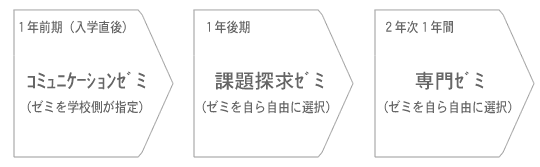
In the second year, students can deepen their studies in areas of interest through Specialized Seminars. In addition to the curriculum structure described above, students can explore fields rarely found at other junior colleges, such as Library Science and Psychology, which is a distinctive feature of the seminars.
The Specialized Courses are a required part of the program, designed to further enhance the skills acquired through the Specialized Program, foster independance, and help students establish their own identity. Under the guidance of faculty members, students are able to navigate freely between research topics, present the outcomes of their two-year college experience through papers, reports, creative works, or other projects.
Every year in late January, a Seminar Presentation Day is held, where all students in the Language and Communication Program participate to showcase their seminar achievements. At the same time, a Recitation Contest is held, featuring presentations in both Japanese and English.
Learning Support Program
- Purpose
In the Language and Communication Program, a wide variety of courses are offered. Yet, across all of them, one ability is essential — the capacity to understand language accurately and express ideas clearly. In other words, a solid foundation in both Japanese and English is key to success.
To help students strengthen these fundamental skills, the college has introduced leveled classes and a step-by-step learning system. This structure allows students to clearly recognize their goals and progress, while instructors can provide tailored, effective guidance suited to each student’s needs. - Overview (Process)
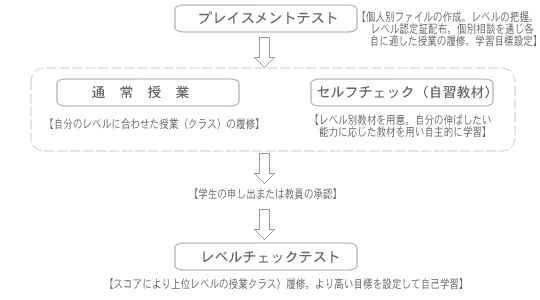
All newly enrolled students are required to take a placement test to assess their foundational language skills. The results help instructors provide personalized guidance on which abilities to focus on and how to improve them.
Students are then assigned to first-semester required courses, such as Japanese Expression I & II, and elective required courses, such as Basic English I & II, to strengthen their basic language skills. In addition to classroom learning, students are also encouraged to engage in self study, with level-specific study materials and self-check tests provided in the Self-Study Center. Instructors monitor progress and incorporate students’ efforts into their final grades.
When students feel confident about their current academic level, they may take a level advancement test. Successfully passing the test allows students to move up to a higher-level class and set new academic goals. This system links effort with measurable progress and encourages students to actively participate in both classes and self-study.
Sample Course Plan
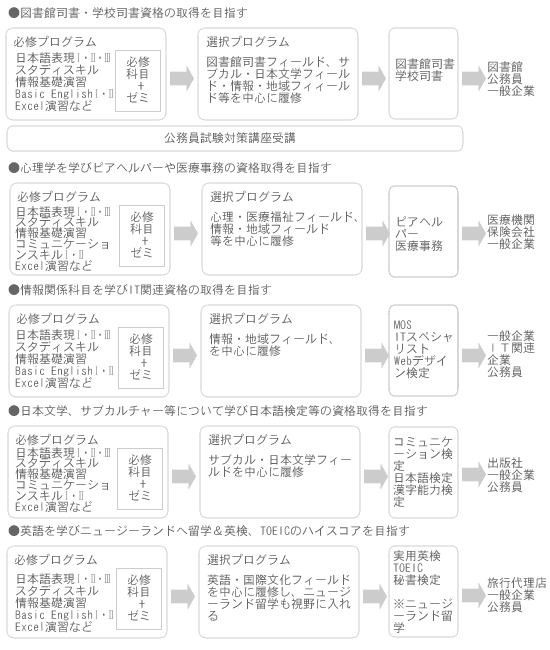
Please refer to the syllabus for the educational objectives of each course.
Early Childhood Education Program
The Early Childhood Education Program sets the following educational goals. Students are encouraged to take these goals as their own and strive to achieve them.
- 1.Cultivate caregivers with a strong sense of mission and ethics, empathetic attitudes, and the motivation to continue learning independently for the best interests of children.
- 2.Develop caregivers with deep understanding and broad knowledge of childcare, early childhood education, and welfare, equipped with flexible thinking to respond to a diverse and changing society.
3.Train caregivers with expertise and cultural literacy who understand child development and can contribute to the healthy growth of children both physically and mentally.
- 4.Foster caregivers with practical skills, including information-gathering and communication abilities, who can collaborate effectively with others in professional settings.
5.Prepare caregivers to actively contribute to sustainable societal development, embracing social responsibility in their professional practice.
Curriculum Structure and Features – Early Childhood Education Program
The Early Childhood Education Program is designed to train childcare professionals and consists of General Education Courses and Specialized Education Courses.Childcare professionals include kindergarten teachers and nursery teachers, and the curriculum is structured so that students who complete the required courses and earn the necessary credits can obtain both the Kindergarten Teacher License (Type II) and the Childcare Worker Qualification.
-
General Education Courses
These courses serve as the foundation of the program in three ways: 。
- Basic learning of communication skills
- Foundation for specialized childcare education
- Liberal arts education as a foundation for career development
-
Specialized Education Courses
Following the Teacher Certification Law and the Child Welfare Act Enforcement Regulations, the program provides essential courses as well as courses that allow students to develop their individual strengths. In the first year, students mainly take required courses to learn the fundamentals of childcare. In the second year, they deepen and broaden their learning through Comprehensive Seminars and elective courses.
Sample Course Plan
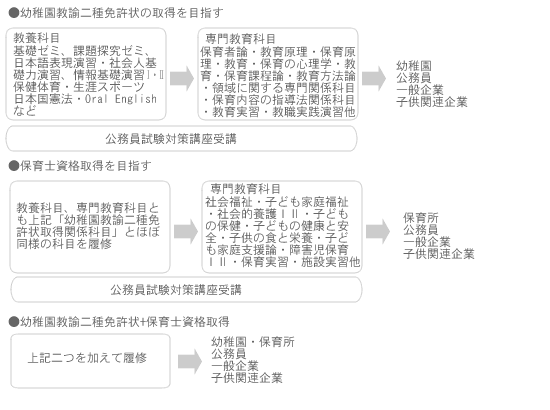
Please refer to the syllabus for the educational objectives of each course.